The Calibration Dividend: Why Measurement Maturity Is a UK Deep-Tech Diligence Signal
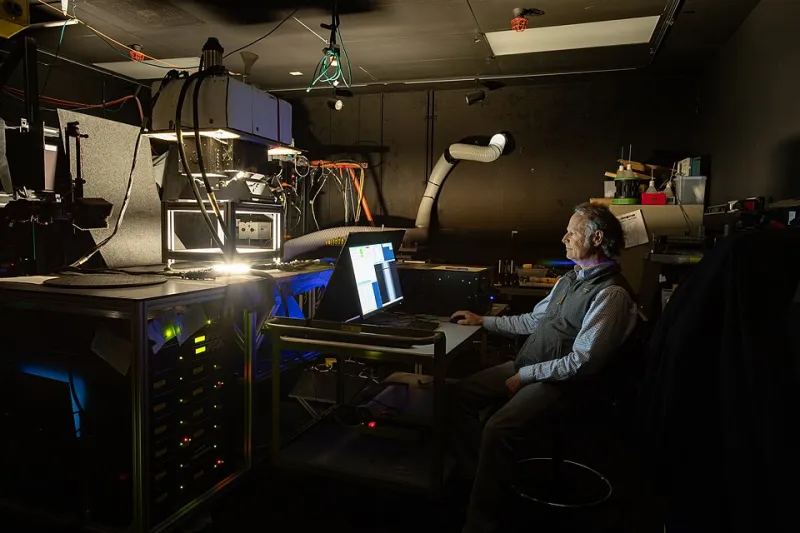
Photo: NASA/Milan Loiacono, Public domain, via Wikimedia Commons
UK deep-tech diligence has a familiar rhythm. Investors examine the prototype, interrogate the bill of materials, walk the pilot line and test the intellectual-property position. Those checks matter. But when a British deep-tech company tries to convert a promising demonstration into an export contract, a less glamorous constraint often decides the outcome: whether the product can be measured, traced and certified to a standard a foreign customer will accept.
That constraint is metrology. It is not simply the act of taking a reading. It is the chain of evidence that connects an instrument, a test method and a production process back to national standards, with a documented uncertainty budget and an accredited laboratory behind it. For investors, measurement maturity is a commercial-readiness signal. For founders, it is often the difference between a technical claim and a sellable specification.
The export gate nobody budgets for
A deep-tech product can perform impressively in a UK laboratory and still fail at the customer’s gate. Overseas buyers in regulated markets increasingly ask for calibration certificates issued under ISO/IEC 17025, evidence of traceability to national standards and a clear statement of measurement uncertainty. Those requirements are not bureaucratic decoration. They determine whether a customer can qualify a supplier, satisfy its own auditor and defend a procurement decision.
This is where many early-stage companies discover a hidden dependency. Their prototype may be excellent, but their measurement infrastructure is informal. Test fixtures may vary between engineers. Calibration may be outsourced without a documented scope. Software may log data without an audit trail. The result is not necessarily a bad product; it is an evidence gap that lengthens sales cycles and can push a deal into a holding pattern.
For investors, the lesson is straightforward. Technical readiness levels describe what a technology can do. Measurement maturity describes whether the company can prove it repeatedly, to an external standard, at the volume and cost the market requires. Those are different questions, and the second deserves a place in 2026 deep-tech diligence.
Britain’s distributed metrology estate
The UK’s metrology assets are not confined to one famous laboratory. The National Physical Laboratory in Teddington remains the anchor, providing national standards and measurement science that underpins traceability. Around it sits a wider estate: UKAS-accredited calibration laboratories, specialist firms serving dimensional, electrical, temperature, flow, torque and pressure measurement, university facilities with niche capabilities, and instrumentation companies that have built calibration services alongside their products.
This estate is easy to overlook because it is distributed and often unglamorous. A robotics company may depend on a small calibration house for force-torque sensors. A materials spinout may need accredited thermal analysis. An energy-hardware developer may require traceable power measurement and environmental testing. These suppliers rarely appear in pitch decks, but they form part of the UK’s deep-tech export infrastructure.
That distribution is both a strength and a diligence risk. It gives founders access to specialist expertise without building every capability in-house. It also means that dependencies can be invisible until a customer asks for documentation. Investors should ask whether the company knows which accredited suppliers sit behind its key measurement claims, and whether those suppliers have the scope, capacity and turnaround time to support export sales.
What measurement maturity looks like in practice
Measurement maturity is not the same as owning a calibrated instrument. It is a system of evidence. A practical diligence checklist should cover the following areas.
- Traceability and accreditation. Can the company show an unbroken chain from its measurements to national or international standards? Are the relevant calibrations performed within an accredited scope, and is that scope appropriate for the product’s claims?
- Uncertainty versus customer tolerance. Does the company understand its measurement uncertainty relative to the specification it is selling? A product that passes internally but sits close to the tolerance boundary may struggle to satisfy a customer’s acceptance test.
- Fixture and method repeatability. Are test fixtures controlled, documented and reproduced across sites? Does the company measure the same way every time, or does the method depend on individual engineers?
- Calibration intervals and drift. Has the company planned recalibration intervals based on evidence rather than habit? Can it show drift history for critical instruments and sensors?
- Data integrity and software controls. Are measurement records attributable, legible, contemporaneous and retained? For regulated customers, spreadsheet-based records and undocumented scripts can become a qualification problem.
- Cost and lead time at volume. Has the company modelled calibration cost per unit, not just per prototype? Throughput constraints in calibration can quietly erode gross margin as volumes rise.
- Contingency and supplier depth. If a single calibration partner is unavailable, can the company still meet customer commitments? Is there a second source for critical measurement services?
- Documentation for export. Can the company produce a customer-ready evidence pack covering certificates, methods, uncertainty statements and accreditation details without a lengthy internal scramble?
These questions are not designed to catch founders out. They are a way to distinguish between a laboratory result and a commercial measurement system. That distinction becomes more important as UK deep tech targets export markets where qualification is part of the purchase price.
The commercial case for getting ahead of it
Measurement maturity also has a positive commercial story. Companies that design for calibration early can reduce rework, shorten customer qualification and protect margin. They can choose sensors and fixtures that are easier to calibrate at scale. They can build a documentation trail that sales teams use as an asset rather than a bottleneck. They can also avoid the common mistake of treating calibration as a post-design service rather than a design constraint.
For investors, the signal is equally useful. A deep-tech company that understands its measurement uncertainty, has accredited partners in place and can explain how calibration scales is more likely to convert technical milestones into revenue. That is a better predictor of export readiness than another laboratory demonstration. It also offers a concrete way to test management quality: measurement maturity requires discipline, documentation and an awareness of the customer’s qualification process.
A diligence signal for 2026
The UK’s deep-tech advantage will not be secured by prototypes alone. It will depend on the unglamorous infrastructure that lets customers trust those prototypes: traceable measurement, accredited calibration and documented uncertainty. Britain already has a deep and specialist metrology base. The opportunity for founders and investors is to treat it as part of the commercial stack, not as a back-office function.
In 2026 rounds, measurement maturity should sit alongside technical readiness, manufacturing readiness and IP position. It is a quiet signal, but a durable one. Export deals are rarely lost because a calibration certificate is exciting. They are sometimes lost because it is missing.