Before the Qubit Cools: Underwriting Britain’s Helium Supply Chain
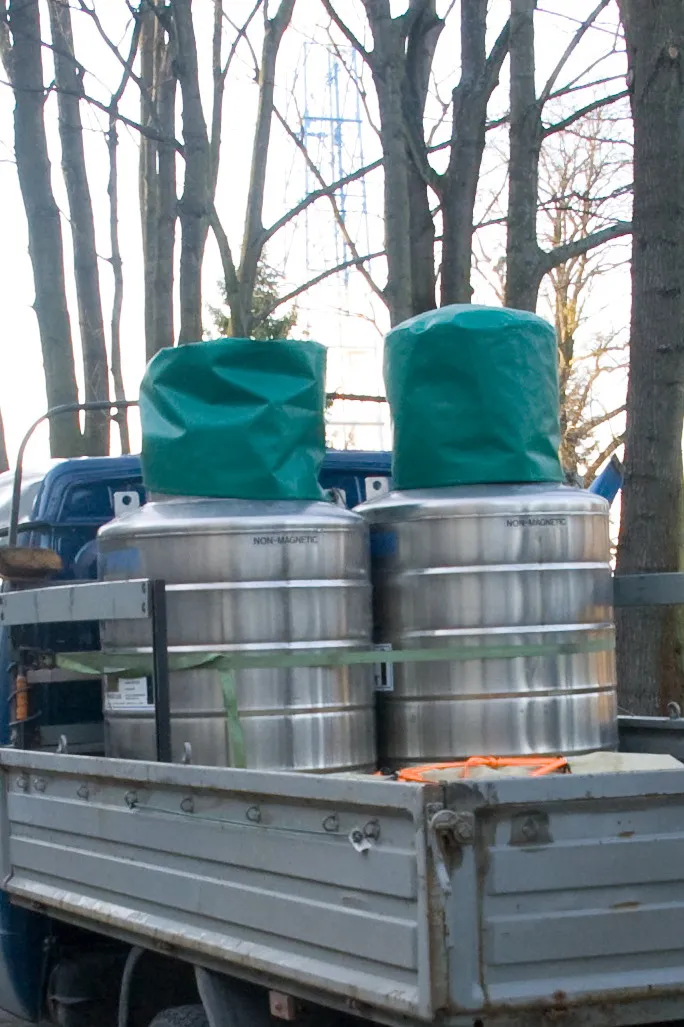
Photo: Andrey Fimushkin, CC BY-SA 3.0, via Wikimedia Commons
A UK deep-tech diligence exercise will usually interrogate power capacity, fab access, key-person risk and the licence to operate. Far less often does it ask a simpler question: where does the liquid helium come from, and what happens to the experiment when it does not arrive? For a growing cohort of British quantum, superconducting, medical-imaging and cryogenic engineering ventures, that omission is becoming harder to defend.
Helium is not merely another consumable. It is a globally traded by-product of natural-gas processing, subject to extraction economics, shipping constraints and a small number of production regions. The UK does not produce primary helium at scale and depends on imported merchant supply, delivered through major industrial-gas companies and specialist distributors. That makes cryogen supply a cross-border operational dependency, not a local facilities contract.
The input that does not appear on the cap table
For investors, the appeal of deep tech often lies in intellectual property, technical milestones and the prospect of defensible margins. Yet liquid helium sits underneath several of those assumptions. Dilution refrigerators, superconducting magnets, MRI systems, particle-physics instruments and certain quantum devices all rely on cryogenic cooling. A lab can have excellent science and still lose weeks of experimental time because a dewar was delayed, a recovery compressor failed or a delivery was allocated to another customer.
The diligence issue is not that helium is scarce in every period. It is that supply is concentrated, logistics are specialised and the product is difficult to store. Liquid helium boils off continuously. Every transfer involves loss. Dewars have holding times, rental arrangements and transport constraints. A site that is distant from a supplier’s hub carries a different risk profile from one located near an industrial-gas cluster, even if both report the same annual consumption.
Mapping the real supply route
A credible diligence pack should identify the legal counterparty, not just the brand on the dewar. Many UK labs buy through distributors rather than directly from a primary producer. That can be perfectly sensible, but it changes the risk picture. The venture may have a contract with a intermediary that has limited visibility of upstream allocation. It may also be on standard terms that permit substitution, price adjustment or delayed delivery during periods of constraint.
Investors should ask for a simple map: annual liquid-helium consumption in litres; the number and location of suppliers; the proportion bought under fixed versus spot arrangements; typical lead times; and the site’s storage capacity. They should also establish whether the venture relies on a single dewar or a single delivery route. A second supplier on paper is not necessarily a second supplier in practice if that supplier has no spare capacity or requires a different purity grade.
Purity matters. Cryogenic applications can be sensitive to contamination, and not every helium stream is interchangeable. A supplier that can serve a balloon-filling operation may not be qualified for a quantum laboratory. Diligence should therefore test specification as well as volume. The relevant question is not simply whether helium is available, but whether the right grade is available within the required timeframe.
Recovery systems and the uptime illusion
Helium recovery is often presented as the mature answer to supply risk. In principle, closed-loop systems capture boil-off gas, purify it and reliquefy it for reuse. In practice, recovery rates vary widely. They depend on capital investment, equipment reliability, operator training, gas purity and the discipline of laboratory users. A recovery system that is poorly maintained can become a source of downtime rather than resilience.
For diligence, the useful metric is not the nameplate recovery rate but the observed rate over a sustained period. Investors should ask for maintenance logs, downtime records and the volume of top-up helium purchased after recovery was installed. If a venture claims 90 per cent recovery, the evidence should show how that figure is measured and whether it holds during peak experimental periods. A lab that recovers most of its helium but depends on one compressor with no service contract is still exposed.
Recovery also has an economic dimension. Reliquefaction equipment consumes power and requires floor space, maintenance and specialist staff. For smaller labs, the capital cost may not be justified by the volume saved. That is a legitimate choice, but it should be modelled rather than assumed. The unit economics of a cryogenic experiment include helium losses, dewar rental, transport and the labour required to manage them.
Contracts as operational constraints
Cryogen contracts deserve the same scrutiny as any other critical supply agreement. Key terms include volume commitments, price-review mechanisms, allocation language, force majeure provisions, delivery obligations and termination rights. A contract that looks inexpensive on a per-litre basis may offer little protection during a supply interruption. Conversely, a higher-priced agreement with guaranteed allocation and emergency delivery may be the better diligence finding.
Investors should also consider assignability and change-of-control provisions. If the venture is acquired or restructured, will the supply agreement survive? Is the contract held by the operating company or by a university partner? Does the site lease permit cryogen storage and delivery access? These are unglamorous questions, but they determine whether the technical roadmap can be executed after the deal closes.
A useful stress test is to model a four-to-eight-week disruption in helium deliveries. What experiments stop? Which milestones slip? Can the venture borrow dewar capacity from a partner? Does it have a prioritisation agreement with a supplier? What is the cost of emergency alternatives? The answers often reveal more about operational maturity than a polished facilities slide.
A line item that belongs in the investment committee
Britain’s deep-tech base is being asked to scale in quantum, superconductivity and advanced instrumentation. Those ambitions depend on cryogenic infrastructure that is imported, specialised and logistically fragile. That does not make every helium-dependent venture uninvestable. It does mean that cryogen supply should be treated as a hard operational constraint, with its own evidence trail, rather than a footnote to the facilities budget.
For UK investors, the practical step is straightforward: add helium to the diligence checklist. Ask where it comes from, how it is recovered, who holds the contract and what happens when the dewar is late. The answers will not replace technical due diligence, but they will sharpen the assessment of uptime, unit economics and execution risk. In deep tech, the cooling system is part of the business model.