Scheduled Interference: The EMC Queue Britain's Hardware Sector Cannot Buy Its Way Out Of
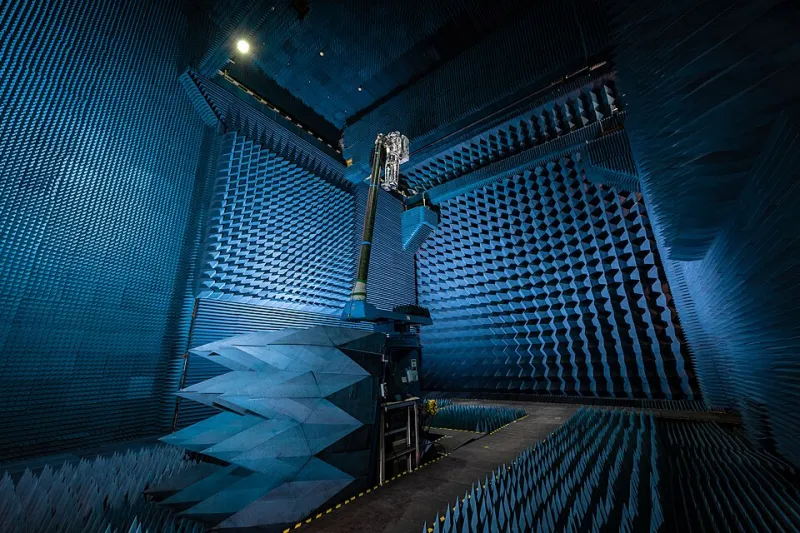
Photo: NASA Johnson Space Center / Norah Moran, Public domain, via Wikimedia Commons
Ask a UK hardware founder what will delay their first revenue shipment and the answers tend to concern tooling, firmware or a supplier in the Far East. Ask again after the design freeze, and the answer is often a chamber in the Midlands with no slot until March.
Electromagnetic compatibility testing occupies an odd position in the British hardware economy. It is mandatory, it is unglamorous, it is comparatively cheap relative to a production line, and it is one of the most reliable sources of schedule slippage in the sector. It also appears in almost no investment memorandum.
One milestone, two calendars
EMC work runs on two parallel calendars, and conflating them is the root of most planning error.
The technical calendar covers pre-compliance: bench measurements, immunity checks, a temporary screened room if the company is fortunate, and the iterative business of reducing emissions from switching converters, motor drives and high-speed digital buses. Good teams do this early and often. It is where the design is actually fixed.
The commercial calendar covers the accredited campaign: a UKAS-accredited laboratory, calibrated receivers and antennas, a defined worst-case configuration, and a test report that a notified body, a customer's supplier-quality team or a distributor will accept. That calendar is governed by capacity, not by effort.
The shape of the queue
Britain's accredited test estate is competent and well-regarded, but it is finite. A limited number of facilities can accommodate large items — industrial cabinets, vehicle platforms, rail equipment, agricultural machinery, medical systems. Demand from automotive electrification, defence programmes, heat-pump and grid-connection hardware and consumer electronics all competes for the same chambers, and a substantial share of that work is booked months ahead by companies with standing agreements.
For a first-time claimant, the practical sequence looks like this: a quotation within a fortnight, a slot eight to sixteen weeks out, a campaign of several days for a typical product family, and then the anxious interval in which the report is written. If the product fails — and first-time passes remain the exception rather than the rule for dense power electronics — a redesign of four to twelve weeks is followed by a retest slot that must itself be won from the queue.
The distinction between pre-compliance and compliance is where founders misjudge costs most often. Pre-compliance tells a team it is probably close. It does not tell them they will pass, and the gap between the two is where programmes die quietly.
What the schedule usually omits
Several recurring omissions turn a manageable milestone into a missed quarter.
Worst-case configuration. A product tested in its friendliest mode, with a short cable harness and a single power supply, may pass and still be unsaleable once a customer specifies an alternative supply or an extension cable. The configuration tested must be the configuration sold.
Standards selection. Generic standards, product-family standards and sector-specific regimes — rail, medical, automotive, defence — differ in limits and in the evidence required. Choosing the wrong test set wastes an entire slot.
Marking regime. Great Britain and the European Union now diverge in the marking they require, even where the underlying technical standards converge. Products intended for both markets need the paperwork for both, and the recognition arrangements in place for CE marking in Great Britain are a matter to check rather than assume.
Retest budget. A serious, ring-fenced reserve for a second and possibly a third campaign belongs in the cost of goods, not in contingency. Teams that budget a single campaign are budgeting for a lucky one.
Witnessed testing. Some customers and some sectors require their own representatives to attend, which extends the slot and adds travel and scheduling constraints.
None of this is exotic. It is simply the ordinary friction of turning a prototype into a product, and it is invisible until it is urgent.
Booking the chamber before the build
The practical inference is straightforward: the test slot should be booked at or before the design freeze, and certainly before tooling commitment. A company that treats the chamber as a resource to be secured once the product is ready has ceded control of its launch date to a third party's diary.
For investors, the diagnostic value is real. A hardware company with a booked, dated test slot, a written pre-compliance plan, a named worst-case configuration and a funded retest reserve is demonstrating something more meaningful than optimism: it understands the last mile between engineering and commerce. A company that answers the question with an intention rather than a date is telling you where the schedule risk sits.
Three questions belong in every hardware board pack long before a funding round. Which accredited laboratory has issued the quotation? What is the confirmed slot date, and what is the cancellation policy? What is the tested configuration, and who signed it off?
The answers are dull, technical and highly predictive. In a sector that often measures progress by technical milestones, the quietest milestone is frequently the one that decides the year.