The Bench-to-Fab Bottleneck: Britain’s Reliance on Imported Lab Kit

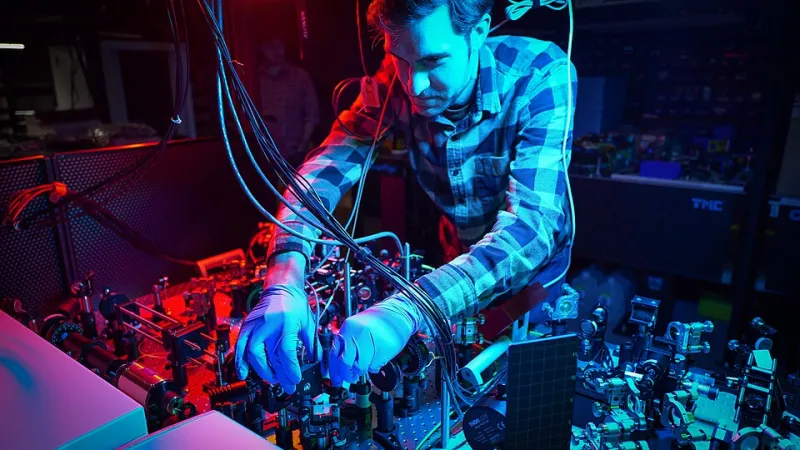
Photo: NASA Glenn Research Center, Public domain, via Wikimedia Commons
Walk into almost any UK deep-tech laboratory and the bench tells a global story. A cryostat from Finland sits beside a mass spectrometer from the United States or Germany; an electron microscope from Japan is a few metres from a photonics bench built around components from Britain, France and the Netherlands. The science may be British, but the toolchain is unmistakably international.
That is not, in itself, a failure. Advanced instrumentation is a global market with deep specialisation, and no country makes every tool. But for a state that has pinned growth hopes on lab-to-fab translation — turning research in materials, quantum, photonics and engineering into products — the provenance of the bench matters more than policymakers sometimes admit. Instrumentation is the invisible layer between a promising result and a manufacturable process. When it is scarce, slow or single-sourced, the bottleneck is not the idea. It is the tool.
The invisible layer between discovery and production
Deep tech is often described as a pipeline from laboratory to factory. The metaphor hides the middle. Before a new material can be scaled, it must be characterised, measured, patterned, tested and certified. That requires cryogenic systems, vacuum equipment, lithography, deposition tools, metrology and a long tail of sample-handling kit. Each item is a small capital decision; together they determine how quickly a cluster can iterate.
For investors, the usual diligence questions focus on intellectual property, customer traction and team quality. Tool access rarely makes the list. It should. A spinout that cannot access a focused ion beam or a high-resolution transmission electron microscope is not merely inconvenienced. It may be pushed towards a slower route, a foreign partner or a different country. The location of tools shapes the location of spinouts long before a factory decision is made.
Where Britain still builds
Britain has genuine instrumentation champions. Oxford Instruments has built a substantial position in cryogenic systems and thin-film deposition and etch tools. Renishaw is a world player in metrology and Raman spectroscopy. Malvern Panalytical is a significant name in materials characterisation. Andor, Gooch & Housego and Teledyne e2v add depth in imaging, photonics and sensors, even where ownership is now international. A wider base of precision engineers, vacuum specialists and software firms supports them.
The geography is more distributed than the headline list suggests. Oxfordshire and Cambridge host instrument makers and analytical software; Glasgow has a photonics cluster; Manchester and Bristol have materials and quantum-adjacent capabilities; Southampton and Leeds contribute in photonics and precision engineering. These are real assets. But many of the firms are mid-sized specialists rather than platform suppliers capable of equipping an entire fab.
Where the chain breaks
At the high end, the gaps are stark. Leading-edge lithography is dominated by ASML in the Netherlands. High-end transmission electron microscopes are largely supplied by Japanese, American and German firms. Mass spectrometry at the premium end is concentrated in a handful of US, German and Japanese companies. Wafer processing depends heavily on Applied Materials, Lam Research and Tokyo Electron. Metrology for advanced nodes is similarly concentrated.
Britain does not need to replicate all of that. Autarky would be expensive and implausible. But the dependency has practical consequences: long lead times, foreign-exchange exposure, export-control risk and service contracts that can leave a publicly funded lab waiting months for a replacement part. For a cash-constrained spinout, the difference between a shared cryostat and a new one can determine whether a funding round is spent on science or capital equipment.
Why the toolchain is an investor signal
Instrumentation is a leading indicator because it reveals the depth of a cluster’s supporting infrastructure. A cluster with shared facilities, trained service engineers and fast access to metrology can support more experiments per pound. A cluster without them may still produce excellent papers, but it will struggle to translate them into repeatable processes.
Due diligence should therefore ask a few unglamorous questions. Where are the critical tools located? What are the lead times? Is there a single point of failure? Who services the equipment? Can the company access public instrumentation through a Catapult or university facility, and on what terms? A strong answer is not proof of commercial success, but a weak one is a warning that the lab-to-fab path is longer than the pitch deck suggests.
What a credible strategy looks like
A serious domestic instrumentation strategy would not begin with a slogan about making everything at home. It would begin with a map of where dependency is most consequential and where Britain already has a right to win. Cryogenics, precision motion, vacuum technology, photonics, metrology and sample handling are plausible areas of strength. So are the software and calibration layers that make instruments usable at scale.
Public procurement can anchor demand. A consortium approach to buying and sharing expensive tools across universities and Catapults would improve utilisation and give domestic suppliers a clearer customer base. Funding for service engineering, calibration and applications support would matter as much as funding for new hardware. Standards work and certification capability would help UK firms sell into regulated markets. And mid-sized champions need patient capital to scale manufacturing, not just grants to prototype.
The goal should be resilience, not isolation. Britain can import plenty of kit and still be a serious deep-tech economy. But it should know which instruments are strategic, which dependencies are tolerable and which gaps would delay an entire cluster. That is a more useful debate than a binary choice between sovereignty and openness.
The scaling test
As 2026 draws to a close, the lesson is that tool sovereignty is not a niche concern for laboratory managers. It is part of the investment case. The UK’s strongest clusters will be those that combine research depth with reliable access to the instruments, service capacity and metrology that turn discovery into production. Investors who ignore the bench may find they have backed a promising science project with a toolchain problem attached.