The Unseen Stack: Where Britain's Quantum Supply Chain Actually Lives
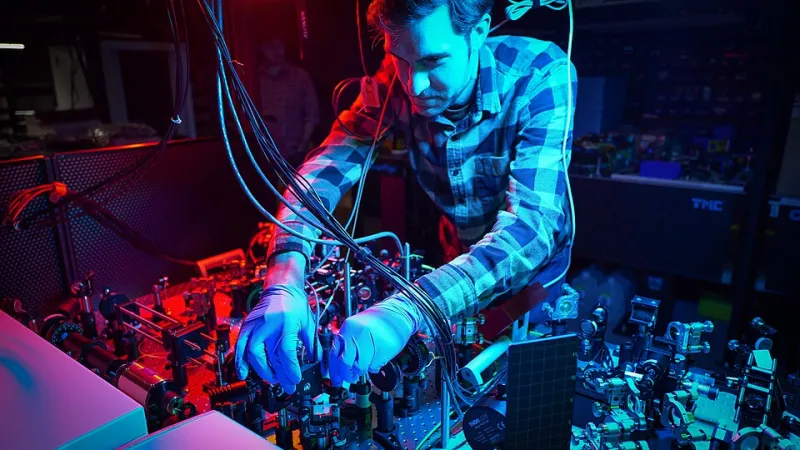
Photo: U.S. Air Force AFRL by Keith C Lewis, Public domain, via Wikimedia Commons
The race to build a useful quantum computer is conventionally reported as a contest between qubit architectures — superconducting circuits against trapped ions, neutral atoms against photonics. That framing is useful for physicists and largely misleading for investors. A quantum processor is, in physical terms, an exercise in applied refrigeration, ultra-high vacuum, precision photonics and radio-frequency control. Almost every element of that apparatus is bought rather than built, and a meaningful share of it is bought from British firms.
That distinction matters commercially. Announcing a qubit milestone is cheap; shipping a dilution refrigerator that holds 10 millikelvin for a decade is not. The suppliers behind the second activity carry recurring revenue, service contracts and process know-how that is genuinely difficult to replicate. They are, in the familiar phrase, the picks and shovels of the sector — and in the UK they are scattered across Oxfordshire, Sussex, South Wales, Scotland and the North West rather than concentrated in any single quantum hub.
Why the picks-and-shovels layer is under-priced
Public funding has, understandably, followed the science. The National Quantum Strategy committed £2.5bn over a decade from 2023, the National Quantum Computing Centre has been built out at Harwell, and the research hubs attach to university departments. The consequence is that the visible pipeline of early-stage companies is dominated by hardware developers and software groups, while the component suppliers sit quietly on the balance sheets of larger, older industrial businesses or in small, founder-owned firms with no obvious venture story.
That creates an information asymmetry. An investor who can read the supply chain can often assess a quantum hardware company's realistic timeline faster than the company's own pitch deck allows — because lead times for a cryostat, a high-stability laser, or a batch of isotopically engineered material are observable, hard to compress, and rarely flattered by optimism.
Cryogenics: Britain's cold chain
Superconducting and spin-qubit systems depend on dilution refrigeration, and the UK has an unusually deep bench here. Oxford Instruments, through its NanoScience business near Oxford, is one of a small global group capable of delivering complete dilution refrigerator systems at scale, alongside its superconducting magnet line. ICEoxford supplies cryostats and custom ultra-low-temperature systems from the same city. The cryogenics engineering group at STFC's Rutherford Appleton Laboratory at Harwell contributes both design capability and the institutional patience that long-horizon instrumentation demands.
Below that top tier sits a wider set of subcontractors: machining, specialist welding, vacuum brazing, low-temperature wiring and sensor calibration. This is where the cluster's real depth lies, and also where its fragility lies. Helium-3, essential to dilution cooling, is a by-product of tritium decay and its supply is tied to a handful of nuclear programmes. Any component supplier whose margins rest on helium handling should be interrogated on inventory strategy before it is interrogated on growth.
Vacuum, lasers and the photonic stack
Crawley-based Edwards Vacuum, now within the Atlas Copco group, is one of the few credible global suppliers of the dry pumps and vacuum systems that sit beneath every trapped-ion and neutral-atom experiment. BOC and other industrial gas suppliers handle the ultra-high-purity gas delivery that atom-based architectures require. Neither is a quantum company in any conventional sense, yet both are structurally exposed to the sector's growth.
On the photonics side the UK's advantage is older and broader. Teledyne e2v in Chelmsford supplies detectors and RF subsystems; Laser Quantum in Stockport builds solid-state lasers used in spectroscopy and ion control; Photon Force in Edinburgh develops single-photon avalanche detector arrays; and the Optoelectronics Research Centre at Southampton underpins a photonics ecosystem that produced hollow-core fibre technology later acquired by Microsoft in 2022. Wales adds III-V compound semiconductor capability through IQE and the CSconnected cluster around Newport. Photonic packaging — the unglamorous business of getting light in and out of a chip without losing it — remains a genuine bottleneck globally and a modest commercial opportunity domestically.
Materials and the diamond question
Element Six, based at Didcot, is among the world's leading producers of synthetic diamond, including material engineered for nitrogen-vacancy centres and quantum sensing. Isotopically controlled silicon, superconducting niobium and ultra-pure ceramics complete a materials stack that is thin everywhere and almost nowhere as strong as in the UK and continental Europe. These suppliers are capital-intensive, qualification-heavy and slow — the precise profile that patient capital should find attractive and momentum capital usually avoids.
Where the chain is thinnest: control electronics
If there is an obvious gap in the British supply chain, it is classical control. The electronics that generate and read the microwave or optical pulses addressing a qubit — and the FPGA and ASIC design that sits behind them — are largely imported from Dutch, Israeli and American vendors. UK capability exists in the design houses clustered around Bristol and Cambridge and in the error-correction decoding work led by Riverlane, but a domestic systems supplier of scale has not yet emerged. That is an investment gap, and arguably a strategic one.
Five questions for the diligence file
- Is quantum genuinely the market, or a marketing adjacency? Several suppliers describe themselves as quantum-relevant while deriving most revenue from semiconductors, fusion or fundamental physics.
- What is the order-book concentration? A component maker with three customers and 18-month lead times has different risk characteristics from one with thirty customers and six.
- How much of the revenue is grant-funded? UKRI and NQCC programmes are excellent validation and poor forecasting.
- Which sub-components come from outside the UK? Imported controllers, cryogenic amplifiers, rare-earth parts and precision connectors all create tariff and geopolitical exposure that rarely appears in a cap table conversation.
- What is the moat — IP, process or service? In instrumentation, the answer is usually calibration know-how and field service rather than patents, and that should be reflected in valuation methodology.
The anchor-tenant effect
Harwell is beginning to function as the sector's anchor. Co-locating the National Quantum Computing Centre with STFC's cryogenics, materials and engineering groups gives component suppliers a reference customer and a shared testbed, which is precisely the mechanism that built the semiconductor clusters of the 1980s. Whether the UK converts that proximity into export-oriented suppliers — rather than a collection of bespoke instrument builders — is the question that will determine which parts of the value chain remain British.
For investors, the practical implication is straightforward. The quantum opportunity is not confined to companies with the word quantum in their name. A disciplined map of the refrigeration, vacuum, photonics, materials and control layers will surface businesses that are already generating revenue, already exporting, and largely invisible to the sector's news cycle. That is where the durable returns are likely to sit.